
If an SEO agency can’t tell you what happens after they build the links, they aren’t doing SEO. They’re guessing. For too long, the marketing world treated search engine optimization like a dark art. You threw money at content and hoped Google noticed. But in the current landscape, that approach is a fast way to burn a budget.
Today, the best agencies aren’t just focused on keywords. They are focused on forecasting. They use data to model revenue before a single line of code is written. We looked at the market to find the firms that treat SEO like a science. Here are the top 10 companies mastering data-based strategy and predictive forecasting.
The Heavy Hitters of Predictive SEO
1. SeoProfy — The Architect of Revenue Modeling
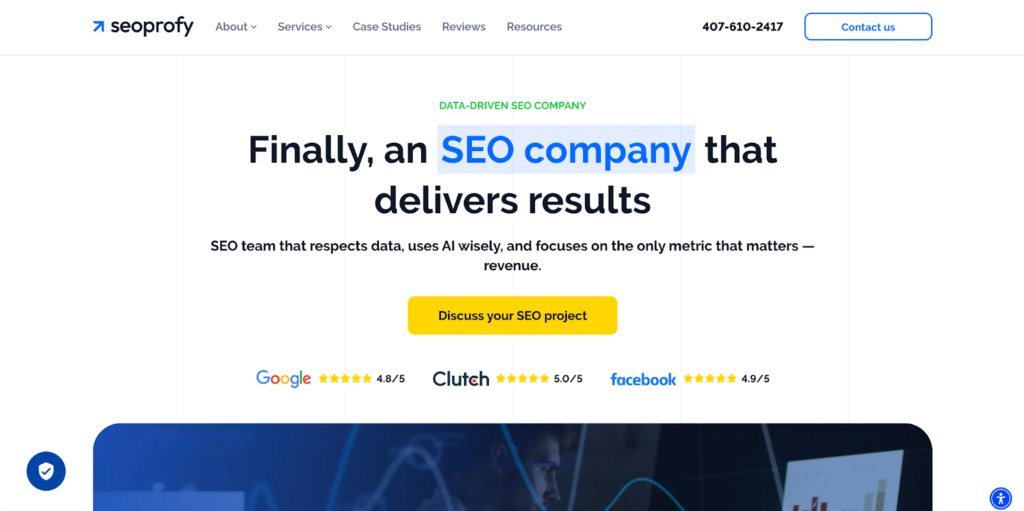
SeoProfy is an SEO agency focused on helping businesses understand the financial impact of organic growth before campaigns begin. Instead of promising vague increases in traffic, the company presents a projected revenue timeline based on data analysis.
Its approach combines technical SEO audits with a proprietary method called “keyword opportunity scoring.” Rather than simply identifying keywords, the agency evaluates each opportunity according to commercial intent and conversion potential.
What they do differently:
- Traffic Forecasting: They map out growth trajectories based on current domain authority versus competitor strength.
- Revenue Modeling: Before the campaign starts, they show you a projection of how organic search will impact the bottom line.
- Competitive Research: They reverse-engineer the data of your top competitors to find the gaps you can own.
For enterprises that need to justify marketing spend to stakeholders, SeoProfy provides the evidence before the work begins.
2. Victorious

Victorious follows a principle that many organizations overlook: strategy should come before execution. The firm is recognized for its enterprise-level approach and places strong emphasis on understanding the reasoning behind every action.
Share of Voice
Rather than sending over a monthly report full of vanity metrics, they focus on “share of voice.” They use comparative data to show you how you stack up against the competition in your specific market segment. Their forecasting models help clients set realistic expectations that align with business cycles.
3. WebFX
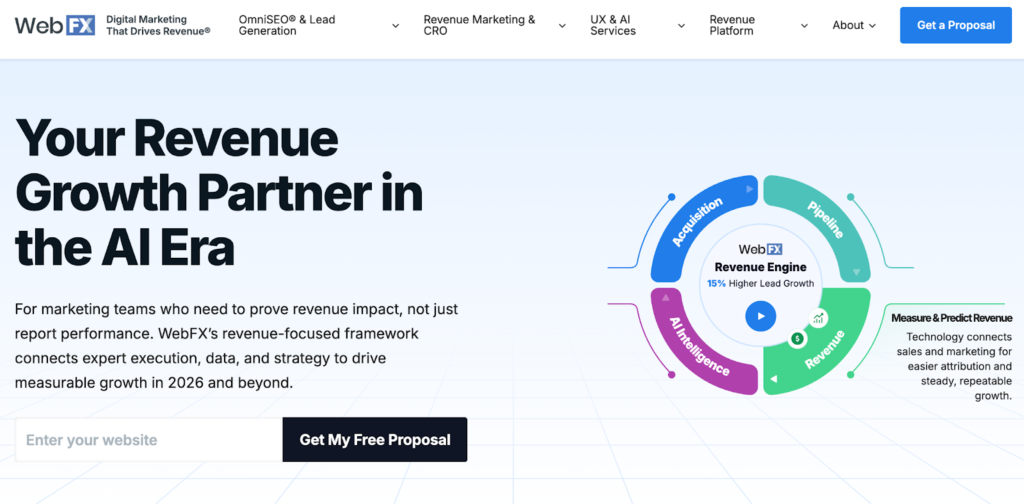
WebFX manages large-scale digital campaigns while continuing to prioritize personalized data tracking. The platform MarketingCloudFX enables the team to follow the entire customer path, beginning with the initial click and ending with conversion.
Data-driven Approach
This platform gives clients a unique view. You can see exactly which keyword led to a phone call or a form fill. They focus on historical data comparison, allowing them to predict seasonal trends and adjust strategies before the market shifts.
Agencies That Specialize in Complex Verticals
4. Thrive Agency
Thrive is frequently chosen by businesses operating in highly regulated industries such as legal services, healthcare, and home services. Its data strategy focuses on identifying local search intent while analyzing highly competitive markets.
Simplified Services
They excel at breaking down complex service areas into manageable data sets. By using granular location data, they forecast which neighborhoods or districts will bring in the highest lifetime value customers, rather than just the highest traffic volume.
5. OuterBox
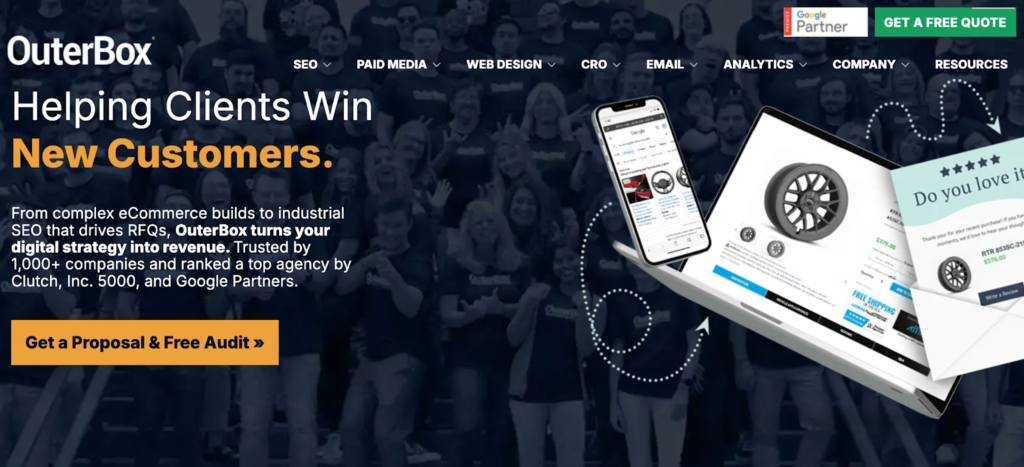
OuterBox is well known for its work in eCommerce SEO. For online retailers, forecasting is not optional; it plays an important role in planning and managing inventory levels.
Search Trends Prediction
OuterBox uses data to predict product demand based on search trends. They help clients understand not just how to rank a product page, but how to structure category pages to capture “non-branded” commercial intent. Their reporting focuses on transactional data, tying SEO directly to shopping cart behavior.
6. HigherVisibility
HigherVisibility takes a “full-funnel” approach to data. They look at the top of the funnel (informational content) and the bottom (commercial keywords) to create a unified strategy.
Forecast Transparency
What makes them reliable is their transparency in forecasting. They use historical performance data to set benchmarks. If a client is in a saturated market, HigherVisibility will use data to show the realistic timeline for entry, ensuring there are no surprises six months into the engagement.
The Boutique Data Analysts
7. SearchBloom
SearchBloom specializes in technical SEO and data analytics for mid-market companies. They are less about content creation and more about unlocking the potential of the website that already exists.
Crawl Data Usage
They use “crawl data” to prioritize fixes based on potential traffic impact. Instead of giving a developer a list of 500 errors, they score each technical issue by how much organic revenue it is blocking. This pragmatic use of data ensures that development resources are used efficiently.
8. SureOak
SureOak is an agency that focuses heavily on B2B and SaaS companies. In the B2B space, the sales cycle is long, and attribution is difficult. SureOak solves this by building custom attribution dashboards.
Focused on Organic Search Growth
They focus on “revenue per visitor” rather than cost per click. Their forecasting models help SaaS companies predict trial sign-ups based on organic search growth, allowing the sales team to prepare for increased lead volume months in advance.
9. SEO Inc
SEO Inc has been in the game for decades, which gives them a massive database of historical data to draw from. They use this legacy data to identify patterns that newer agencies might miss.
Competitive Conquesting
Their approach is heavily focused on “competitive conquesting.” They analyze the backlink profiles and content strategies of market leaders to find weaknesses. They then build data-driven campaigns designed to “steal” market share, rather than just grow a brand’s existing footprint.
10. First Page Sage
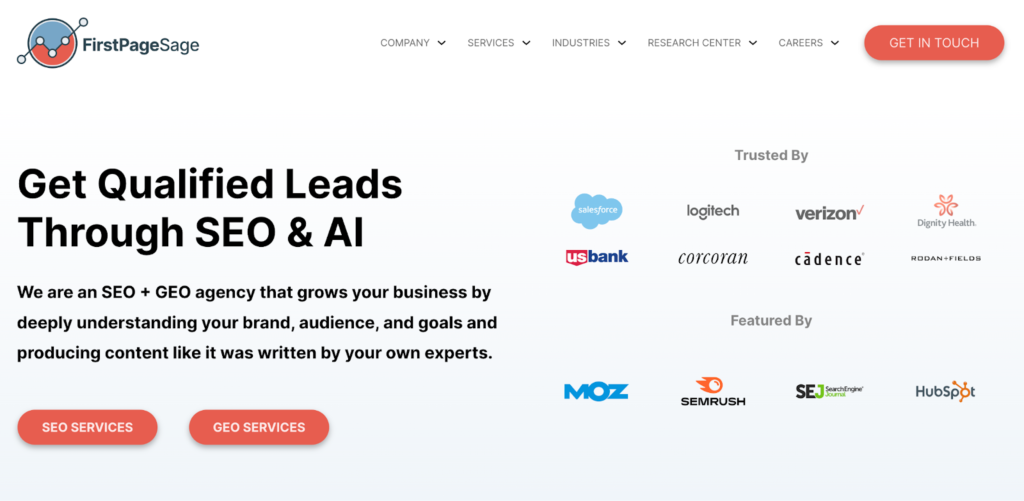
First Page Sage is known for their “E-E-A-T” (Experience, Expertise, Authoritativeness, Trustworthiness) methodology, but they apply strict data parameters to it.
Leadership Search Demand
They focus on “thought leadership” SEO. For them, the data determines which topics a company’s executives should be experts in, based on search demand. They forecast the authority needed to rank for high-stakes, high-value terms, creating a roadmap that aligns personal branding with search algorithms.
Moving Beyond the “Month-to-Month” Gamble
When you look at these ten companies, a pattern emerges. They don’t sell widgets. They sell clarity. The old way of hiring an SEO agency involved a lot of hand-waving. You paid a retainer, they built some links, and if rankings went up, everyone was happy. But if sales didn’t follow, no one could explain why.
Data-based strategy removes that ambiguity
- Forecasting sets the budget.
- Competitive research defines the battlefield.
- Revenue modeling proves the value.
It forces a conversation about business goals rather than just keyword density.
So, Which One Do You Choose?
Finding the right partner isn’t about picking the biggest name on the list. It’s about finding the team that understands the story behind your numbers.
If you are an e-commerce brand struggling with product categorization, OuterBox likely has the data set you need. If you are a SaaS company trying to justify SEO to a board of directors, SeoProfy’s revenue modeling will give you the ammunition you need to secure that budget.
The bottom line is this: stop paying for activity. Start paying for insight.
Ask any agency you interview to show you a sample forecast. Ask them to explain, using raw data, how they plan to move the needle. If they can’t show you the math, they are just hoping for the best. In a market where every click has a cost, hope is not a strategy.
Choose the agency that treats your business metrics with the same respect they treat Google’s algorithm. That is the agency that will still be delivering value five years from now, not just until the next update hits.